A Grainy Video, a Teenager, and a Global Conspiracy: The Tall Tale of Cameron Robbins
The video is shot at night aboard a brightly lit ship. While the evening’s dance music reverberates out from behind them, onlookers peer down from the ship’s side into the murk of the coastal waters just off Athol Island, the Bahamas. A pale figure is in the water, a highschool graduate named Cameron Robbins, the video beginning seconds after he had jumped in. He butterfly strokes through the waves, glittering in the night as they reflect the vibrant lights from the party boat. Someone tosses a circular lifebuoy into the water in an attempt to coax him back but Cameron turns away from it, swimming instead toward the ship’s aft end where he vanishes from view. The video ends. I won’t link it here — it is, after all, the final moments of a teenager’s life — but it isn’t difficult to find online.
It all happens in less than 30 seconds but it’s enough to convince thousands of people that the story they have been told through official channels is incorrect, possibly deliberately so: Cameron didn’t drown, but was attacked and then consumed by a shark, right there in the video. You can visit reddit, Twitter), and I’m sure other social media spaces to find posts like this. Some media sources have entered the frenzy: behold this headline from The Mirror : “Horrifying final two words to teen before he was mauled to death by shark” (the article makes no mention of sharks beyond the headline or a casual mention 10 paragraphs down that, yes, there are sharks in the ocean).
The contradictory research is out there, of course; sharks don’t usually attack humans, and when they do they rarely finish the job. Sharks eating people is an event so rare, in fact, that it makes the news every time it happens , and is often triggered by human behaviours such as feeding in their habitat waters.
Ask an expert on sharks, someone who studies them for a living, and they’ll explain people simply aren’t a part of the menu sharks eat from. Usually, when a shark attacks a person, it is because they’ve adopted the shape of one of their common prey animals, like seals. A person splashing in the water at the surface, it is said, can trigger the prey response in a shark that might test the potential meal the only way it can: by biting it. Most shark attack stories go the same way, with a surfer or swimmer being bitten by a shark, then released. Bloody and traumatized, victims sometimes have the strength to swim to safety.
Humanity tastes bad.
But shark attacks do happen, and they happen in the Bahamas , so what is up with this Cameron Robbins essay?
Initially exploding on TikTok in videos rife with speculation, the shark theory has since moved to online discussion boards like reddit’s r/cameronrobbinsSHARK. Over there they KNOW that Cameron was attacked by sharks:
“He’s torn in half within a second or two by a large shark coming up from underneath and taking his legs/ lower torso in its mouth”
“I'm totally convinced he was attacked by one or more sharks.”
“If you zoom in and scrub very slowly through the footage with the brightness turned all the way up it becomes very graphic- a frenzy.”
They present their evidence of multitudes of still frames from the video: shapes and shadows, what looks to be reflections from the ship. If you watch it now you might find it hard to discern what these people are seeing — it really is just a video of cameron swimming in the ocean. There’s no shark fins, no blood, no torsos or wayward limbs or anything else they claim is in the video. This is because these people aren’t watching the same video you’re watching: they’re watching ‘enhanced’ videos with color/contrast/brightness cranked all the way up and a filter applied. Under such circumstances the wave-tops become fins, the reflections from the party boat become large shark bodies slithering just under the surface, and the cry of a party-goer who just witnessed someone leap from a ship into open ocean is turned into Cameron’s own screams of pain as he thrashes around in the bloody water.
“YES!! You can see the shark’s thrashing tail and part of its lower body very quickly come out of the water, right after its head emerges behind Cameron. At this point, it has bitten him in half just below the ribs and then it jerks to the left. Cameron doesn’t really move because that second very large shark has (at least) his entire right arm in its mouth at the same exact time, and it’s basically a bit of tug of war, with his body caught in between them.”
There are other contradictions and mistakes in the online discussions. The ship, it is claimed, is owned by Disney who wishes to suppress knowledge of the true cause of death so as not to disrupt their cruises (it isn’t a cruise ship and it isn’t owned by Disney). Cameron was ‘dared’ to jump in (according to witnesses, it was his own drunken decision and some bystanders tried to talk him out of jumping). Cameron was pushed in (again, multiple witnesses say he was not). No one who has witnessed the jump has spoken up (they have) and have had their voice suppressed by the government.
Sharks are vicious machines who want nothing more than to devour humans as soon as they jump into the ocean… in movies like Stranded, Deep Blue Sea or The Shallows. They make a good antagonist for a two hour film — an unstoppable force of nature and an unfeeling machine with only a singular purpose.
The recent proliferation of true-crime podcasts, the party atmosphere and youthful setting of the video, and the evolutionary ability for humans to see patterns in things that aren’t there and these have all come together in the perfect storm to sire a grand conspiracy theory. Comments are deleted, people are silenced, videos are taken down… all by some mysterious “they” that wants to keep you ignorant of the man-eating sharks.
The Bahamian government is involved, as they made official statements about some things that were contradicted in future statements. As is common in events like this, the first few hours are a muddled mess of revolving info as officials begin to piece together the true sequence of events. The narrative changes several times through the day as they learn more about the situation, while at the same time the public and media are pressing for more info. Something has to be said, usually in a conference room before a mic stand with two dozen reporters in attendance. It is in these moments of silence, in the back of the class room, in dark corners and on the internet, where rumors grow.
So what is that conspiracy? What are the powers that be trying to do here? According to the ‘sharkbelievers’, why is this all happening?
To save the reputation of sharks.
It wouldn’t be the first time this has happened. 1977’s Jaws kicked off a fascination and fear of sharks that hadn’t existed in the American population up to that point. A series of similar movies over the decades, in addition to Discovery Channel’s yearly ‘Shark Week’ shark-attack-palooza, conditioned the population to believe sharks were in the water waiting for the chance to grab us, that they could smell a single drop of blood from miles away, and that they loved the taste of human flesh and actively sought us out when we went swimming. Things were dire at the time, the fear leading to popular action from some governments to cull hoards of sharks. Marine biologists had to do quite a bit of work to improve the image of sharks in the public’s mind, creating and appearing in their own documentaries and insisting we should be fascinated by sharks, not scared of them. They took a stance of education and it worked as we saw shark populations begin to climb for the first time in decades starting in the 90’s.
Common in conspiracy theories is the idea that the evidence that would blow the story wide open is being withheld, or that video/photographic evidence did once exist but has since been scrubbed from the internet. And you’ll see the same in discussions about Cameron Robbins: shadowy elements go to great lengths (and massive expense) to ensure that this evidence never gets to the public, often to contradictory ends; the parents of the victim use their own money to hush up people about the shark attack that killed their son; the Bahamian government wants to keep tourism high so they made his classmates sign NDAs before they’re allowed to leave the country; the US media is pressured by the federal government to not report the attack because the United Stated federal government has a stake in the ‘shark-friendly’ research groups.
Because the members of shark-spiracy have been analyzing the same 15 seconds of footage for three years now, and while still no one can agree on what exactly they’re seeing, I thought I would include some of their top-rated images of the shark for your own careful study:
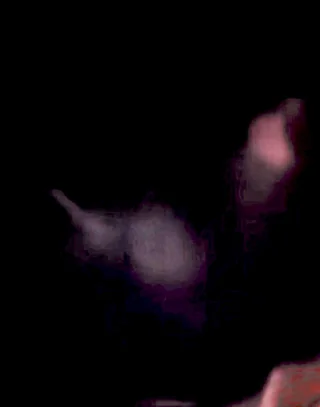
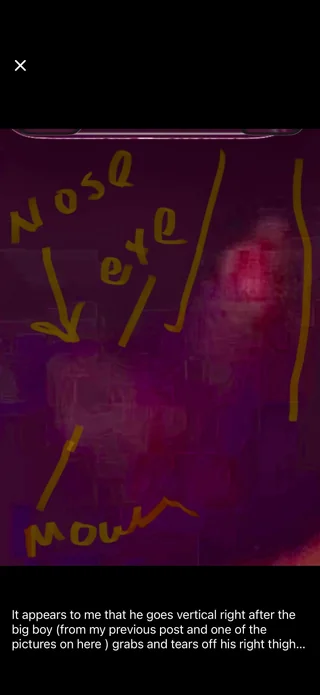
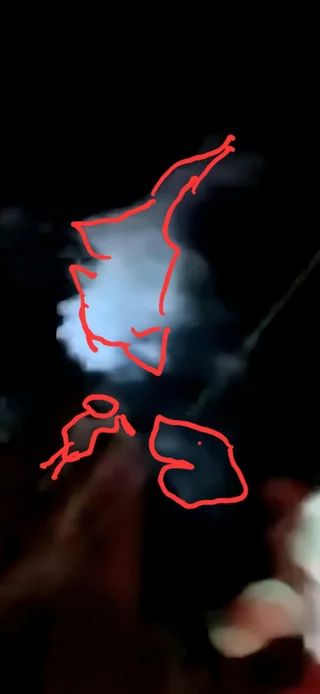
What do you see?